
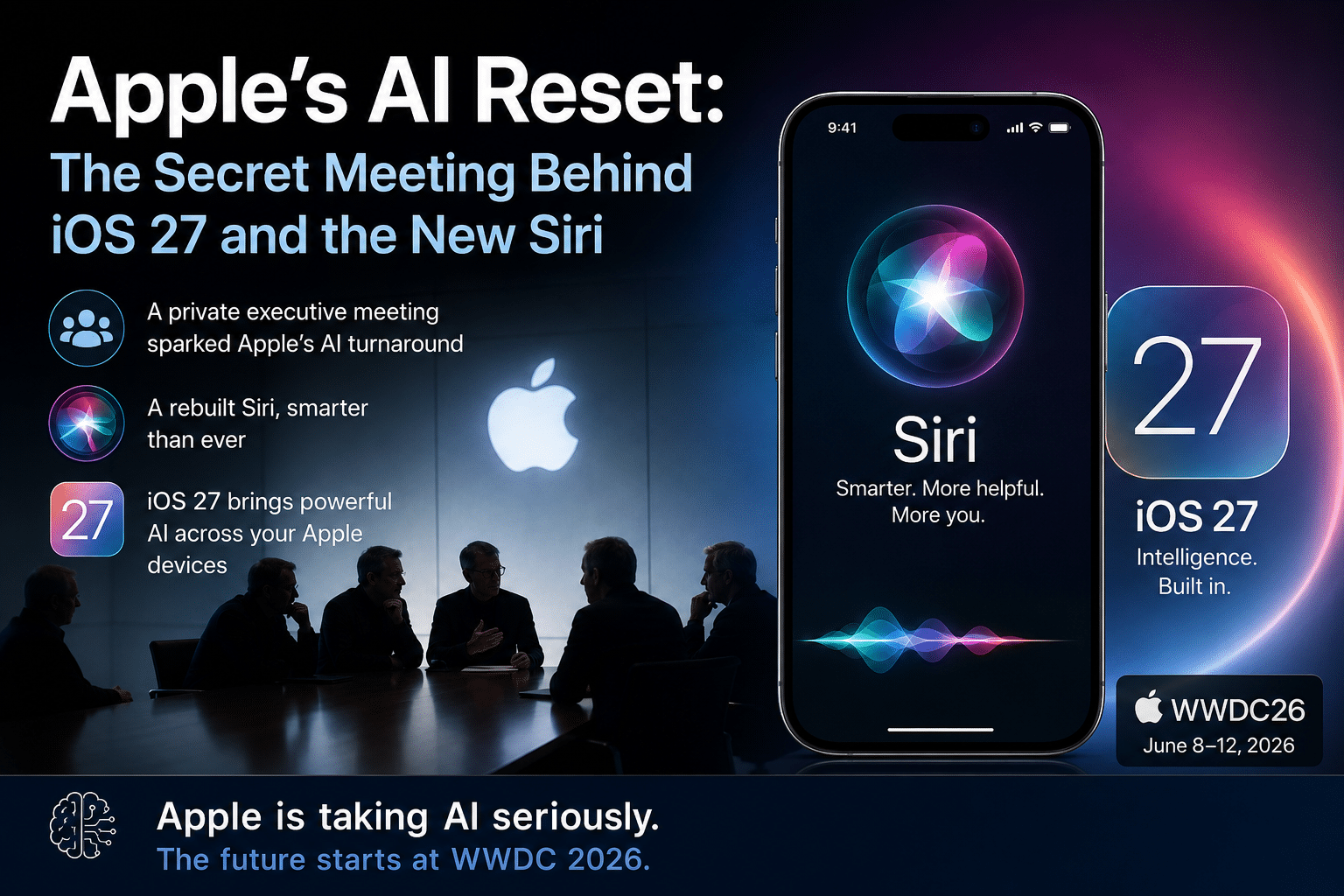
Apple is preparing for one of its most important WWDC events in years — and this time, the story is not just about new software. It is about Apple admitting, quietly but decisively, that it had fallen behind in artificial intelligence.
According to Bloomberg’s Mark Gurman, Apple’s renewed AI push can be traced back to a private executive meeting in early 2025. The meeting reportedly brought together senior Apple leaders to confront a problem that had become impossible to ignore: Apple Intelligence had not delivered the breakthrough many expected, and the long-promised Siri upgrade was slipping further behind competitors.
Now, with WWDC 2026 about to begin, Apple is expected to show the results of that internal reset through iOS 27, a rebuilt Siri, and a more serious AI strategy across the iPhone, iPad, Mac and wider Apple ecosystem.
A Turning Point for Apple Intelligence
Apple Intelligence was meant to mark the company’s arrival in the modern AI race. Instead, its early rollout left many users feeling underwhelmed. While rivals pushed ahead with powerful chatbots, image tools and contextual assistants, Apple’s approach felt cautious, limited and slower than expected.
That caution has long been part of Apple’s culture. The company has traditionally preferred to wait, refine and release technology only when it believes the experience is polished enough for mainstream users. That approach helped Apple reshape industries with the iPod, iPhone, iPad and Apple Watch.
But AI has moved at a different speed. ChatGPT, Gemini, Claude and other AI systems changed user expectations almost overnight. People no longer want a voice assistant that simply sets timers or checks the weather. They expect an assistant that can understand context, answer follow-up questions, control apps, summarise information and help complete real tasks.
For Apple, that created a serious challenge: Siri had become one of the company’s weakest links.
The Secret Meeting That Changed Apple’s AI Direction
Bloomberg reports that Apple executives met in early 2025 to discuss just how far behind the company had fallen in AI. Tim Cook was reportedly not present at that meeting, but the discussion helped shape the recommendation that Apple needed major leadership and structural changes around Siri and artificial intelligence.
The reported meeting appears to have been a turning point. Apple recognised that incremental improvements would not be enough. Siri needed more than a new interface or a few clever commands. It needed a deeper rebuild.
That is where Craig Federighi and Mike Rockwell become important figures in the story. Federighi, Apple’s software chief, is understood to have taken a leading role in shaping the company’s AI response. Rockwell, known for his work leading the Vision Pro project, reportedly became central to fixing Siri — one of Apple’s most visible and long-running weaknesses.
This matters because Apple’s best products have usually come from tight control between hardware, software and user experience. If Siri is now being treated as a core platform rather than a bolt-on assistant, Apple may finally be preparing to give it the attention it has needed for years.
iOS 27 Could Be Apple’s AI Comeback Moment
WWDC 2026 is expected to introduce iOS 27, alongside updates to Apple’s other operating systems. While last year’s iOS 26 brought the major Liquid Glass redesign, iOS 27 is expected to focus more heavily on intelligence, performance and deeper system-level improvements.
The rebuilt Siri is likely to be the headline feature.
Instead of behaving like a traditional voice assistant, the new Siri is expected to move closer to a conversational AI system. That could mean users are able to ask more natural questions, continue conversations, search across apps, and carry out more complex actions on the iPhone.
The most important shift is not simply that Siri may become more talkative. The real change is that Siri may become more useful.
For years, Apple users have trusted the iPhone because it is reliable, private and simple to use. If Apple can bring those same values to AI, it could offer something different from the current chatbot market: an assistant that is not just clever, but properly integrated into the device people already use every day.
Apple’s Big Reversal on Chatbots and AI Photography
One of the most interesting parts of the Bloomberg report is the suggestion that Apple has changed its mind on areas it previously resisted.
Apple executives were reportedly cautious about chatbot-style interfaces and AI-led photography features. That now appears to be changing. With iOS 27, Apple is expected to lean more openly into AI experiences that once seemed outside its comfort zone.
That could include more powerful Siri conversations, smarter search, better image tools, and deeper AI assistance inside Apple’s core apps.
This is a major cultural shift. Apple has never liked chasing trends. It prefers to define categories on its own terms. But AI has become too important for Apple to sit back and let OpenAI, Google, Microsoft and Anthropic shape the future of computing without a stronger response.
Why Siri Matters More Than Ever
Siri is no longer just a feature. It is becoming a test of Apple’s future.
If the next generation of computing is built around AI agents, voice control, contextual search and personal assistants, then Apple cannot afford for Siri to remain second-class. The iPhone may still be the most important consumer technology product in the world, but the way users interact with devices is changing.
Typing, tapping and swiping will not disappear. But AI will increasingly sit above apps, helping users move between tasks more naturally.
That is why iOS 27 could be more important than it first appears. A better Siri could become the bridge between today’s iPhone and Apple’s next era of devices, including smart glasses, foldable iPhones, home devices and future mixed-reality products.
Tim Cook’s Final AI Push
Another key part of the story is Tim Cook’s role. Bloomberg’s reporting suggests Cook has become more directly involved in Apple’s AI comeback following the troubled Apple Intelligence rollout and delayed Siri upgrade.
That is significant. Cook’s legacy at Apple is already secure in many ways. He turned Apple into a services powerhouse, expanded its global supply chain, built the Apple Watch into a major product and oversaw enormous financial growth.
But AI may become one of the final tests of his leadership.
If Apple can use WWDC 2026 to show a convincing AI strategy, Cook leaves the company with a stronger foundation for the next decade. If the new Siri feels unfinished or underwhelming, Apple risks looking reactive rather than visionary.
The TechStorm View: Apple Needs More Than Promises
Apple does not need to win the AI race by shouting the loudest. That has never been its strength. What Apple needs is to make AI feel calm, useful and trustworthy.
The company has a major advantage: it controls the hardware, software, operating system, app ecosystem and privacy architecture. No other consumer technology company has quite the same end-to-end control.
But Apple also has a problem: users have heard promises about Siri before.
WWDC 2026 needs to show real progress. Not vague demos. Not carefully worded future features. Apple needs to prove that Siri can understand context, work across apps, protect user privacy and genuinely save people time.
If Apple gets this right, iOS 27 could mark the beginning of a serious comeback in AI. If it gets it wrong, the gap between Apple and its AI rivals will become even harder to ignore.
Final Thoughts
The story behind Apple’s AI reset shows a company under pressure, but also a company capable of changing course when it needs to.
Apple has been here before. It has arrived late to categories and still transformed them. The iPod was not the first music player. The iPhone was not the first smartphone. The Apple Watch was not the first smartwatch.
The question now is whether Apple can do the same with AI.
With iOS 27 and the new Siri, WWDC 2026 may be the moment we find out.